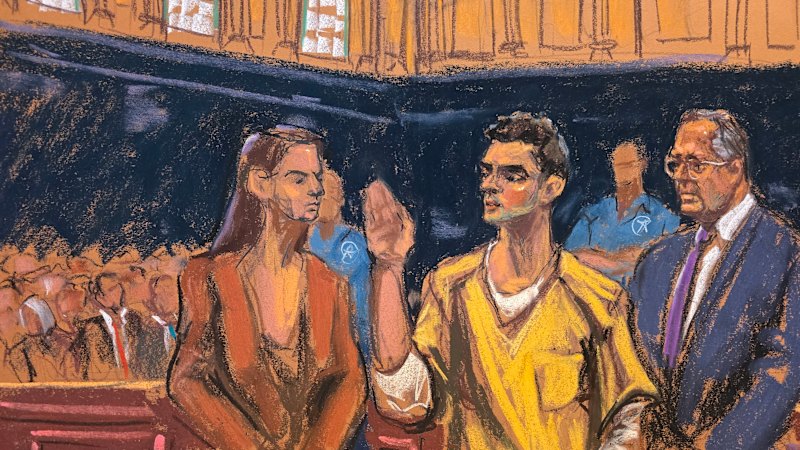
The judicial resolution of high-profile acts of targeted violence relies on clear legal taxonomies rather than public grievance narratives. When Luigi Mangione entered a guilty plea in a Manhattan federal court for stalking charges resulting in the death of UnitedHealthcare executive Brian Thompson, the proceeding crystallized the intersection of federal jurisdictional reach, concurrent state prosecutions, and the rigid mechanics of criminal sentencing without a plea agreement.
By admitting to the shooting outside a Midtown Manhattan hotel, Mangione bypassed a scheduled federal trial, leaving open a distinct legal battleground regarding double jeopardy and state-level murder charges. Deconstructing the case requires examining three operational dimensions: the erosion of capital punishment vectors, the jurisdictional friction between state and federal courts, and the structural friction of institutional healthcare grievances manifested through criminal acts.
The Shrinking Penalty Matrix
The federal prosecution underwent a significant structural shift prior to the guilty plea. Initially exposed to capital punishment under directives from the Department of Justice, Mangione's penalty exposure contracted when U.S. District Judge Margaret Garnett dismissed the death-penalty-eligible firearms charge.
This judicial pruning altered the strategic calculus of both the defense and the prosecution. Without a plea agreement offering sentencing concessions, and with the capital threat removed, the federal case narrowed to stalking resulting in death, carrying a maximum sentence of life imprisonment.
- Charge Architecture: The federal indictment focused on interstate stalking mechanics, leveraging pre-offense surveillance, false identity procurement, and digital communications across state lines.
- Sentencing Exposure: Federal guidelines, paired with the mandatory 85% service threshold before release eligibility, position the upcoming December 18 sentencing hearing as a decisive terminal point for the federal docket.
- Evidentiary Integrity: The survival of core physical evidence—including the 3D-printed firearm recovered during his arrest in Altoona, Pennsylvania—precluded any viable factual defense, converting the proceeding into an admission of liability.
Jurisdictional Redundancy and Double Jeopardy
The coexistence of federal stalking charges and Manhattan state murder indictments created a procedural bottleneck. Defense counsel moved to dismiss the pending New York state murder case, arguing that prosecuting the defendant twice for a singular homicidal act violates constitutional protections against double jeopardy.
State prosecutors, however, maintain that distinct sovereigns—the federal government and the State of New York—possess separate statutory interests. The state indictment, which previously lost its terrorism enhancements when a state judge dismissed the terror-related counts, still centers on second-degree murder.
The mechanics of this conflict test the limits of the dual-sovereignty doctrine. While a federal guilty plea closes one avenue of litigation, state prosecutors have signaled readiness to proceed with trial preparations, setting up a legal clash over whether sequential trials for the same physical conduct constitute an administrative duplication or a constitutionally permissible enforcement of distinct penal codes.
The Operational Mechanics of the Attack
Public discourse frequently conflates the perpetrator's stated motivations regarding chronic back pain and insurance denials with the tactical execution of the crime. The operational blueprint executed on December 4, 2024, demonstrated methodical preparation:
- Information Retrieval: Posing as an institutional investor via email to secure schedule confirmations from corporate leadership.
- Transit and Evasion: Utilizing commercial bus lines, false identification documents under an alias, and pre-arranged urban displacement routes through Central Park.
- Weaponry Logistics: Assembling a non-traditional firearm utilizing 3D-printing technology to bypass standard retail background checks and serial number tracking protocols.
This sequence highlights a recurring vulnerability in executive protection frameworks: public corporate investor conferences rely on open registration models designed to facilitate liquidity and stakeholder engagement, which inherently conflict with high-threat threat-mitigation protocols.
Institutional Friction and Public Resonance
The widespread public reaction to the homicide stems less from the tactical specifics of the crime and more from systemic friction points within the American third-party payer apparatus. Mangione's courtroom statements attributing his actions to institutional navigation failures tapped into broad consumer frustrations regarding claim denials, prior authorization delays, and administrative bureaucracy.
However, judicial authorities consistently draw a sharp line between systemic critique and unlawful violence. The formal separation between legislative or regulatory reform and criminal vigilantism remained a central theme for prosecutors, who emphasized that homicide operates outside the boundaries of legitimate political or social discourse.
Track the resolution of the pending state-level motions regarding double jeopardy to determine whether New York proceeds with its September murder trial or if the federal life-sentence exposure concludes the state's prosecutorial mandate.