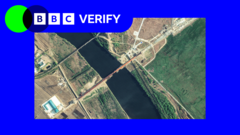
Satellite imagery now confirms the near-completion of a major road bridge spanning the Tumen River, physically cementing the growing military and economic alliance between Pyongyang and Moscow. This isn't just a bit of civil engineering. It is a strategic pivot. By replacing or supplementing the aging, restrictive rail-only connection, Kim Jong Un and Vladimir Putin are constructing a permanent high-capacity artery designed to bypass Western sanctions and move heavy hardware with speed. While the world watches the front lines in Ukraine, the logistics of a new, defiant axis are being poured in concrete and rebar at the edge of the Russian Far East.
Beyond the Rail Bottleneck
For decades, the link between North Korea and Russia was a relic of the Cold War. The Druzhba (Friendship) Bridge served as the sole terrestrial connection, but it was limited by the inherent constraints of rail transport and different track gauges. Rail is predictable. It is easily monitored from space. Most importantly, it requires a massive logistical footprint to load and unload specialized cars.
A road bridge changes the math entirely.
Automotive transport allows for granular, rapid movements. A convoy of trucks can be camouflaged, dispersed, or mixed with civilian cargo in ways a train never can. This new span, located near the Khasan-Tumangang border crossing, provides the throughput necessary for a sustained exchange of resources. Russia needs shells and basic ballistic technology; North Korea needs food, fuel, and the advanced telemetry data required to make its missile program more than just a loud threat.
The Geopolitics of Asphalt
The timing of this construction reveals the desperation and the calculation of both regimes. Construction didn't start in a vacuum. It accelerated as Russia found itself squeezed by international export controls and North Korea looked for a way to monetize its massive, if dated, munitions stockpiles.
China remains the silent, perhaps slightly annoyed, observer in this triad. While Beijing has long been Pyongyang's primary benefactor, this direct line to Moscow gives Kim Jong Un a second lung. It provides leverage. If Beijing tightens the screws to appease Washington, Pyongyang simply shifts its weight toward the Tumen River. For Putin, the bridge is a middle finger to the G7. It proves that the "isolation" of Russia is a Western fantasy that ends where the Siberian taiga meets the Korean Peninsula.
Strategic Redundancy as a Weapon
Military planners look for "single points of failure." The old rail bridge was exactly that. A single well-placed strike or even a mechanical failure could sever the umbilical cord. By adding a high-capacity road bridge, the two nations are building strategic redundancy.
This is about volume. We are talking about the ability to move thousands of tons of cargo daily without the "stop-and-go" nature of rail yards. Standardized shipping containers can now move directly from North Korean factories to the back of Russian military transport trucks, destined for the logistics hubs behind the Donbas.
Infrastructure as Sanction Evasion
The technical specifications of the bridge—its width and load-bearing capacity—suggest it is built for more than just the occasional diplomat's limousine. It is built for heavy-duty freight.
Under current UN sanctions, this kind of trade is illegal. But sanctions only work when there is a point of enforcement. On a bridge controlled on one side by a nuclear-armed pariah and on the other by a permanent member of the UN Security Council currently at war with a Western-backed neighbor, there is no one to check the manifests. The Tumen River has become a legal black hole.
What we are seeing is the birth of a shadow economy that has its own physical infrastructure. It is a closed loop.
- Raw Materials: Russia provides the steel and the engineering expertise.
- Labor: North Korea provides the manual force, often in conditions that would be flagged as human rights violations elsewhere.
- Purpose: To ensure that neither regime is ever truly cut off from the tools of war.
The Engineering of Secrecy
The "how" of this bridge is as telling as the "why." Satellite passes have caught the rapid progression of the piers and the decking. This was not a slow-burn project. It was a sprint. The speed of construction suggests that the engineering hurdles—shifting riverbeds and harsh seasonal temperatures—were bypassed through sheer political will and a total disregard for environmental impact or long-term structural finesse.
It is "good enough" engineering. It is functional, brutal, and fast.
The bridge also serves a psychological purpose. It is a visual signal to the local populations and the international community that the partnership is not a temporary marriage of convenience. You don't build a bridge of this scale for a short-term arms deal. You build it because you intend to be neighbors, and partners, for the next fifty years.
The Role of the Russian Far East
Khasan, the Russian town at the terminus, has long been a sleepy outpost. That is changing. We are seeing increased activity in the surrounding rail heads and warehouses. The bridge is the centerpiece of a larger regional revitalization—one focused entirely on the logistics of an illicit war economy. Russia is tilting its entire internal axis toward the East, and this bridge is the final link in that chain.
Monitoring the Flow
The intelligence community is now faced with a much harder task. Monitoring a rail line is a matter of counting cars. Monitoring a multi-lane road bridge requires a level of persistent surveillance that is difficult to maintain 24/7.
How many of those trucks are carrying grain? How many are carrying drone components or short-range ballistic missiles? The ambiguity is the point. By creating a high-volume corridor, the regimes are "flooding the zone," making it impossible for analysts to distinguish between humanitarian aid and lethal assistance without ground-level access that will never be granted.
The bridge is nearly finished. The paint is likely drying on the guardrails while the first convoys are being staged in the hills of North Hamgyong Province. The diplomatic world can issue all the statements it wants, but the reality on the ground is now set in stone.
Watch the tire tracks in the dust. They lead directly from the factories of the North to the battlefields of the West.